Our Techniques
The craft of handmade
From initial sketch to fine finishing, discover the techniques we use to handcraft each piece of jewelry.
The craft of gold
Handmade at Burgant means more than “touched by hand. Every piece of jewelry that leaves our workshop has been crafted by artisans from start to finish, from the first sketch to the very last polishing and ultrasonic vibrating.
On this page, we take you through the techniques we use every day. Not as a technical manual, but as an insight into what craftsmanship really means.
Would you like to see how your jewelry is made? Visit our workshop by appointment , we will be happy to tell you more about the specific making process for your piece of jewelry.
17 crafts
17 Crafts
Overview of techniques
Processing of precious metals
Machining techniques
In our workshop we apply all the time-honored techniques that have formed the foundation of goldsmithing for centuries, supplemented by the latest methods. Below is an overview of the working techniques we master.
The melting point of gold: 1063 degrees Celsius.
Basic Machining
Melt
The story begins at the fire.
Smelting is the most fundamental step in goldsmithing. At Burgant, we regularly work with old, precious gold that clients bring in. The gold is heated to its melting point of exactly 1063 degrees Celsius, after which it becomes completely liquid.
In that liquid state, gold is completely moldable: we pour it into a bar, a plate or some other basic form. After cooling and solidifying, the actual making process begins, forging, rolling, drawing.
Through smelting, we give old gold a new life. A precious ring, a broken link, a forgotten bracelet, they become the raw material for a new piece of jewelry that can last for generations again.
Basic Machining
(Pre)Forging
Power and finesse, the primal form of goldsmithing.
Forging is the primal form of goldsmithing, a technique that is thousands of years old and used daily in our workshop. The metal is kneaded between hammer and anvil and shaped into the desired form.
At Burgant, we do both hot and cold forging. In the cold state, the metal hardens slightly, an effect called work hardening. When the metal becomes too stiff, we anneal it so that it relaxes and becomes malleable again.
Forging requires both strength and finesse. Hit too hard, and the metal cracks. Too soft, and nothing changes. It is a dialogue between craftsman and material that takes years of practice.
Hammer and anvil, the goldsmith’s two most basic tools.
Rotating cylinders bring the metal to the exact desired thickness.
Basic Machining
Rollers
Evenly, step by step.
Rolling is the feeding of metal through rotating steel cylinders to make it uniformly thinner and smoother. This sounds simple, but the art is in the gradation.
We roll in small increments, a little thinner each time, so that the metal does not crack or crack. After every few rolls, we anneal the metal to prevent work hardening.
Each thickness has its application: thin wire for filigree work, thicker sheet for a solid ring. The roller is one of the most frequently used machines in our workshop.
Connection Technology
Soldering
The connection that holds everything together.
Soldering permanently joins parts of a piece of jewelry together. We use our own solder for each precious metal: an alloy with a melting point slightly lower than the precious metal itself.
At just the right moment, the solder melts and flows into the seam.
Too early or too late, and the connection fails or the jewelry is damaged.
Goldsmiths know several types of solder: extra soft, soft, medium, hard and extra hard. By using them in the correct order, you prevent previously soldered joints from loosening in subsequent operations.
The burner heats the solder at the right time melts and fills the seam.
Hammers, punching and endless patience, this is how a driven piece of jewelry is created.
Design Technology
Logging out
From flat metal to a shape.
Is the craft of shaping a flat sheet of precious metal by driving it into the desired shape with hammers and special tools. Deforming the metal gradually creates depth, volume and character.
Basic Machining
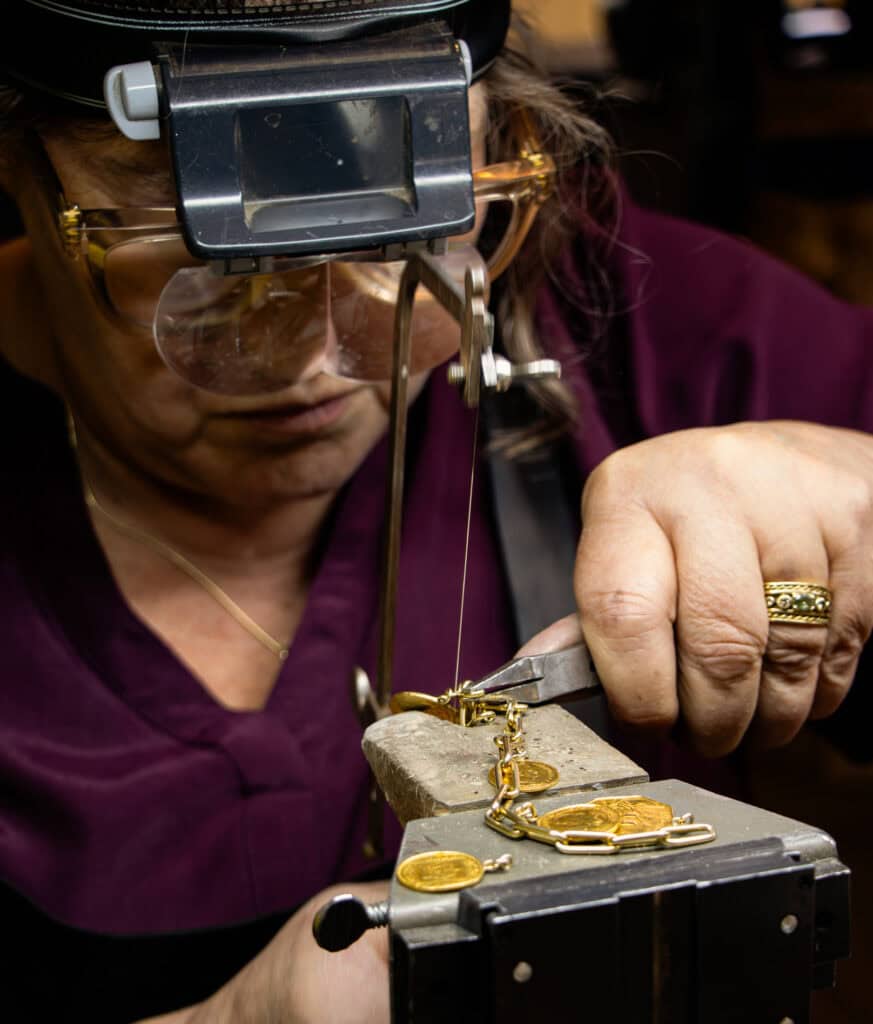
Saw
The right shape from the metal.
Sawing with a saw bracket is a technique that appears in almost every piece of jewelry. Whether it is a rough silhouette or a finely carved pattern, the saw is almost always present.
There are dozens of thicknesses of saw blades from thick and strong for a ring binder, to paper-thin for filigree patterns. Sawing requires quiet, consistent motion and a practiced hand.
The saw blade breaks quickly with a wrong move. Practiced goldsmiths repair a break in seconds, beginners sometimes practice for hours before they can save a blade. Precision is key here.
Finishing Technology
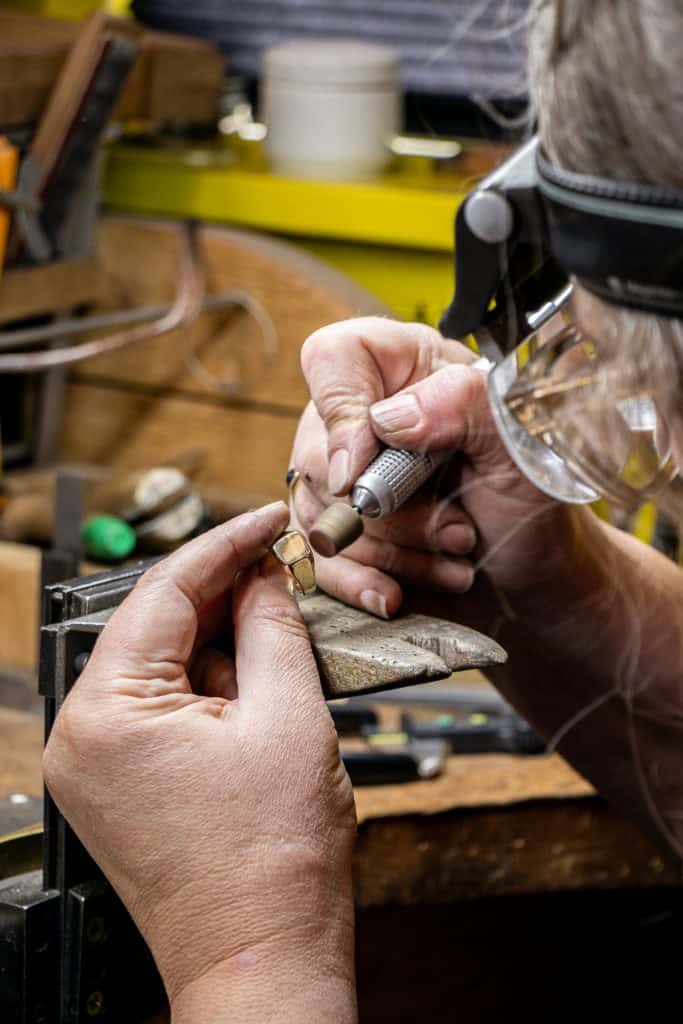
Filing & Sanding
Step by step to perfection.
After shaping and soldering comes the fine finishing: filing and sanding. We start coarsely, with files, sharpening sticks and coarse sandpaper, and slowly work to finer and finer grains.
At Burgant, this process is never skipped unless the nature of the jewelry demands it. With organic jewelry, we deliberately leave the raw surface visible; the character is in the imperfection.
The quality of filing and sanding largely determines how beautiful the polished end result will be. If any scratches remain, they will become painfully visible during polishing.
Finishing Technology
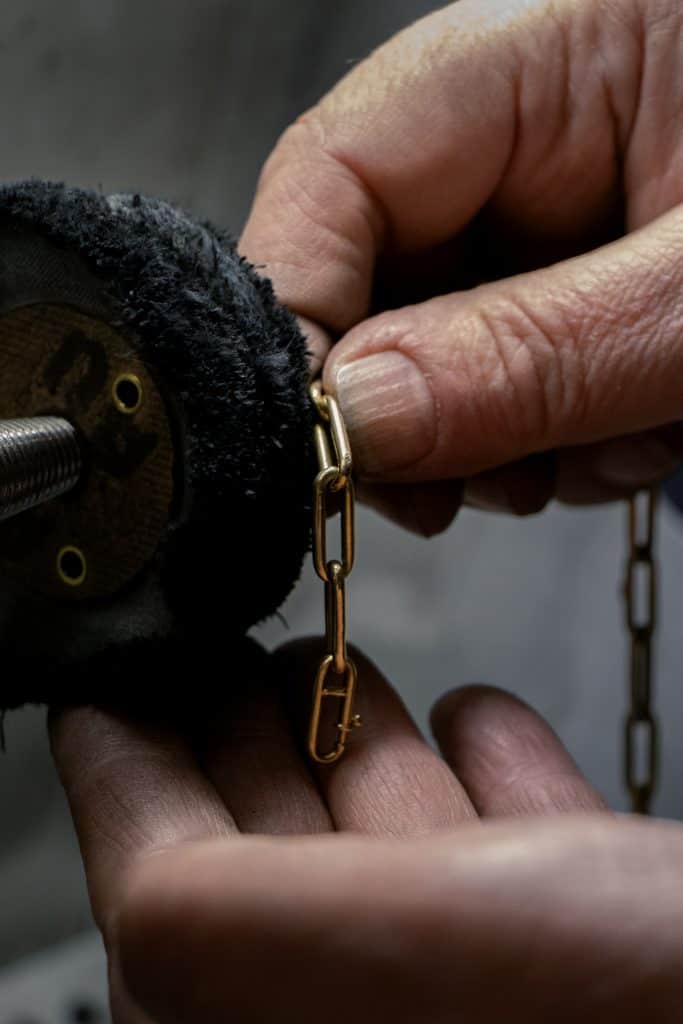
Polishing & Buffing
Like a mirror.
Polishing is the moment when the jewelry comes to life. With rotating brushes and increasingly fine polishing pastes, we work the surface smooth and shiny.
Then comes buffing, a final treatment with a soft rag or buffing machine that gives the jewelry its final high gloss. The difference is subtle but unmistakable: after buffing, the jewelry seems to shine.
A well-polished piece of jewelry speaks for itself. At Burgant, we pay extraordinary attention to this step because it determines the first impression when you first hold the jewelry in your hands.
Lost wax and Delft casting, two time-honored techniques, both alive and well.
Production Engineering
Casting
From liquid metal to solid form.
Casting is one of the oldest techniques in goldsmithing. At Burgant, we work with two traditional methods: the lost wax method and the Delft casting method.
In the lost wax method, a wax model is surrounded by plaster mass. After heating, the wax melts away and the liquid metal is poured into the resulting cavity. After cooling, you break open the plaster mold and have the first raw piece of jewelry.
The Delft method uses Delft earth as a casting mold, particularly suitable for single pieces, where unevenness is allowed. We cast both new gold and the treasured gold of clients.
Modern technology
3D Printing & Casting
Tradition and technology hand in hand.
The most modern addition to our repertoire: 3D printing combined with the lost wax method. After a design session in our studio; – sketch, -digital model, -feedback, we print the design in wax.
That wax model then goes through the modern casting procedure. The result: a precision that cannot be achieved with pure handwork. Therefore, the possibilities are inexhaustible … and we can save in time.
We believe that tradition and technology are mutually reinforcing. Many goldsmiths look at 3D skeptically; we see it as a powerful tool alongside our hammers and files. The choice is up to the client.
Decorating techniques
The art of decoration
In addition to machining techniques, Burgant has a wide range of embellishment techniques. With these we give each piece of jewelry its unique character, from a subtle hammer blow to a millimeter-accurate laser engraving.
A steady hand and years of experience, hand engraving is an art.
Decorating technique
Engraving
Your story, literally in the metal.
Engraving is the insertion of text, drawings, monograms or coats of arms into metal, with engraving cutters, either manually or by machine. An engraved text makes a piece of jewelry irreplaceably personal.
We engrave in precious metals (gold, silver, platinum), as well as in layer stone of signet rings. Large or curved jewelry, a cufflink, a cover, we work entirely by hand.
The choice of hand engraving or machine engraving depends on the design, material and desired look. At Burgant, we are happy to advise you on the best solution for your jewelry.
Decorating technique
Laser Engraving
Millimeter precision.
Laser engraving is a modern technique that applies text and designs with an accuracy of hundredths of millimeters. The laser minimally burns away the metal, perfect for fine fonts, logos and even photographs.
At Burgant we work with this particular machine ourselves for the most detailed engravings. This allows us to realize designs not possible with hand engraving.
Laser engraving is ideal for the more complex designs such as: images, weapons or handwriting.
Laser engraving, every detail accurate to the hundredth of a millimeter.
Each stroke is different, hammered makes each piece of jewelry unique.
Decorating technique
Hammersmith
No two strokes are the same.
Hammer striking is one of the most characteristic decoration techniques. Hammers and punches are used to hammer decorative patterns and motifs into the surface. It gives the jewelry a lively, handmade somewhat organic character.
Each piece is unique because no two hammer blows are identical. Depending on the size and shape of the hammer, different patterns emerge: rough and expressive or fine and controlled.
Hammersmithing is beautiful on wide ring bands, bracelets and pendants. Combined with a polished interior, it creates a beautiful play between rough and smooth.
Decorating technique
Milling
Geometric craftsmanship.
A suspended motor and various cutters are used to mill patterns and motifs into the metal. This produces a tight, defined pattern, different from the organic imprint of hammerblow.
Milling is used for geometric patterns, motifs and decorative edge work. The hanging motor allows us to work with great precision on small surfaces.
The combination of milling with engraving and matting produces particularly beautiful results. In one piece of jewelry, several techniques can coexist and reinforce each other.
A hanging motor with milling cutter works out hair-fine patterns in the metal.
Matte and glossy surfaces side by side, subtle contrast to great effect.
Decorating technique
Matting
Soft, serene, timeless.
Matting gives the metal surface an attractive, silky matte finish. This is achieved with special brushes or matting stones that work the surface at a microscopic level.
Matting is often combined with polished pieces; the contrast between matte and shiny gives the jewelry depth and character. A wedding ring with a matte exterior and a polished interior is a timeless choice.
A matte surface is less prone to minor scratches and fingerprints than a high-gloss surface, a practical advantage that is also aesthetically consistent with modern tastes.
Gem setting
The icing on the cake
The jewelry is not complete until the stone is in it.
Settlements we control
Case setting, stone enclosed by metal rim
Chaton setting, narrow claws hold the stone
Pavé setting, multiple stones close together
Corona setting, crown of metal holds the stone
Invisible setting, stones without visible metal
Bezel setting, flat edge around the stone
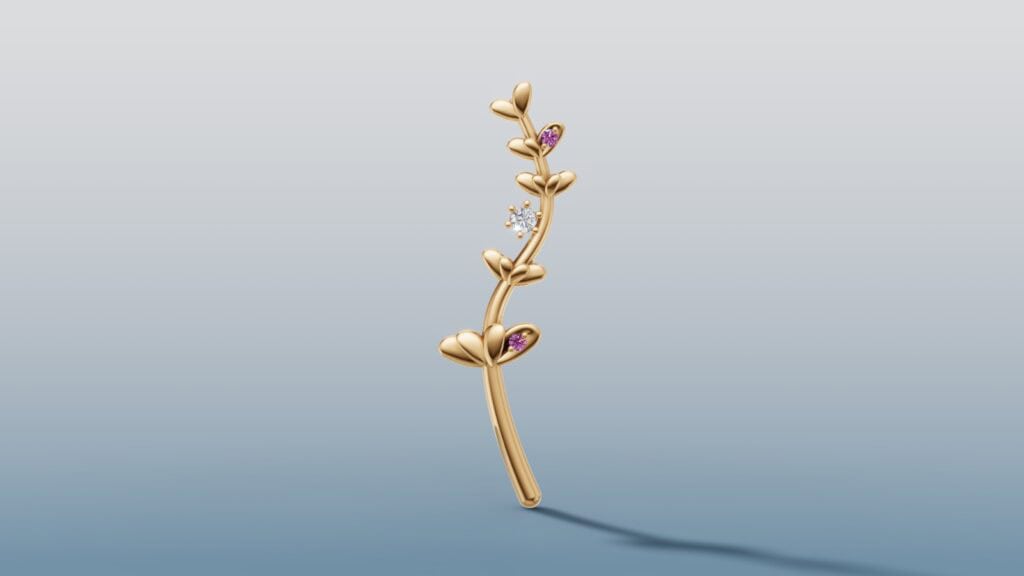
For us, setting gemstones is the highlight of any piece of jewelry. After all the processing, decoration techniques and polishing, the stone is set, and the jewelry is complete. At Burgant, we set gemstones with the utmost care and craftsmanship.
We create a beautiful gold setting, or seamlessly integrate the settings into an existing piece of jewelry. Do you have your own gemstones that need to be reset? We are happy to do so, giving new life to your precious jewelry.
LAB-Grown diamonds
Genuine and affordable
Lab grown diamonds are real diamonds, with the same chemical and optical properties as natural diamonds. The difference is in their origin: rather than deep in the earth, they are created under controlled conditions with advanced technology. This often makes them a conscious choice for those who value sustainability, transparency and attractive value for money.
At Burgant, we specialize in incorporating lab grown diamonds into unique, handmade jewelry. In recent years we have built a special network in this, allowing us to purchase the finest stones directly from the makers. Without unnecessary intermediaries, just honest, transparent and at a good price for you. This way we can not only carefully advise on shape, color, cut and quality, but also design a special piece of jewelry that perfectly fits your wishes and story.
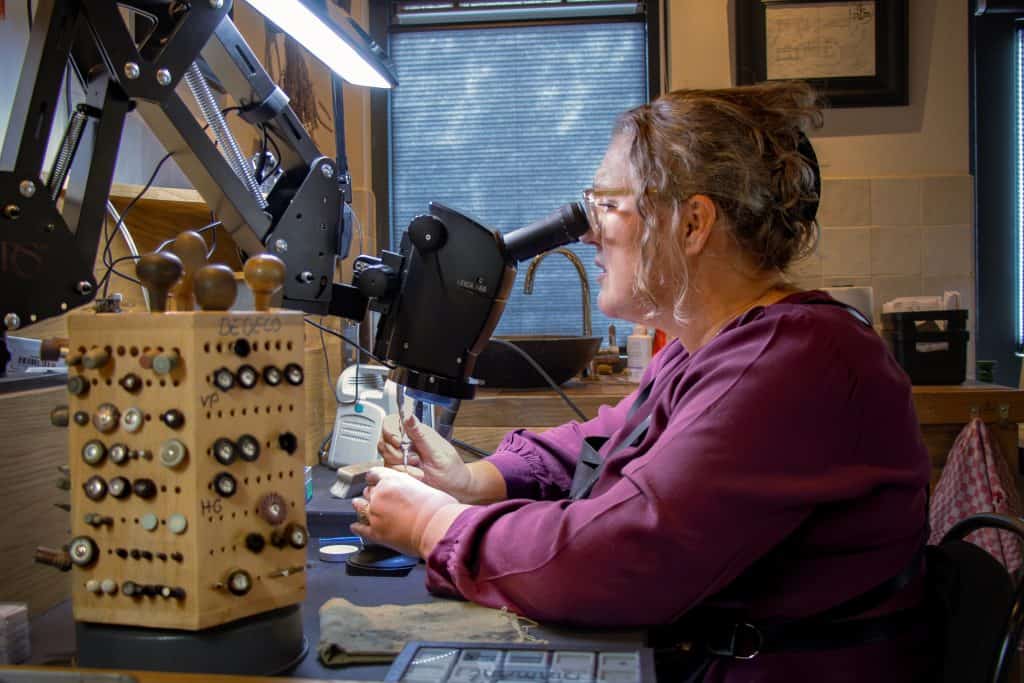
Burgant Atelier
More than craftsmanship
Every piece of jewelry begins with a conversation
Visit our workshop and discover how we turn your idea into a piece of jewelry that can be cherished for generations. By appointment, personally, with full attention to your story.